Tuesday, April 09, 2019

H : Henchmen & Policemen in Hindi Films / Bollywood #AtoZChallenge 2019

Gangs of Wasseypur (GOW), is the first Hindi film I remember, where casting director played a huge role. I don't think casting of films was taken seriously before this in India. In this two-part movie, each and every character had his or her unique personality. No one else could have played Faisal better than Nawazuddin Siddiqui or Ramadhir Singh better than Tigmanshu Dhulia. It felt like that these faces and body types were meant to play these roles. A crime film about mafia, goons and dons had Faisal play this much feared gangster. A gangster who looked not like one. He looked starved. Before this, Hindi Films always had these goons who were bulky and looked fearsome. I think the casting of GOW was a winner. 

Another interesting aspect here was the character arc, each goon had. Each of them had their own back story and own motive. This was new. Before this an actor playing a henchman / goon / policeman (until and unless the main plot revolves around him) was easily replaceable with any other actor. These goondas (henchmen) didn't really have a voice. Their loyalties always lied with the main villain. There was no existential crisis ever. Their job was to bash lesser characters and get bashed by the heroes. Sometimes they will get extended roles, where they will get to do a little more, like a dialogue or two. Or kidnap hero's girl friend. But mostly you wouldn't care much about these henchmen. Similarly policemen in Hindi films were almost always shown as these undisciplined  officers who don't have a real voice. They just bark orders they receive from some one senior. And they reach late on crime scenes. Only when hero is the policeman, they are better off. 

This led to a situation where stereotyped characters were played by stereotyped actors. So in umpteen Hindi films we saw M.B. Shetty (Yes, he is director Rohit Shetty's father) playing a nameless goon or a henchman named Shetty. So imaginative! He rarely spoke in his films. So I don't remember him for his histrionics. I remember him because he was such a cliche about how a goon should look like that he appeared in every goon role possible. Here is the list of his filmography  

Shetty

There are few more actors, whom you will remember seeing playing henchmen, in several Hindi movies from 70's to 90's but most probably won't know their names. They had their time under the sun when cliches ruled the roost. They might have even got one or two bigger roles. But they remained henchmen till the end. Sudhir, Mac Mohan and Mahesh Anand are some names that come to the mind. They are better known because they played the same role so many times, that some one had to ask. Who is he? 

Iftekhar
Policemen and Law enforcers didn't do any better in this aspect. Iftekhar almost always played a policeman (of course of varying ranks and orders). Yes, he had played leading roles in his prime and had also played other characters too. But he has played the highly stereotyped, nice but ineffective policeman, so many times on screen that you won't remember him for anything else. Then there was Manmohan Krishna who was quintessential Seth ji, the man with the money and silken robe and a cigar. Sometimes, heroine's father too. But essentially another nice guy stereotype. There is a scene from the movie Trishul, where Shetty had a little bigger role with dialogues. And he had a character name too. Madhav Singh. Incidentally, this film also had Iftekhar and Manmohan Krishna playing some characters, cast against type. (Click here to view the video.)

Clearly, a casting director's job (if there was any) in Hindi films from 60's to 90's was relatively easy. "Take two Shetties, one Sudhir, one Iftekhaar and lets take Dharmendra as the hero. Heroine? Anyone who is willing to dance in front of these henchmen."

---


Monday, April 08, 2019

G : God in Hindi Films / Bollywood #AtoZChallenge 2019

God is everywhere in India! Not only in hearts and temples, but also in its marriages, deaths, rituals, opening ceremonies and of course in Hindi films. God is not only in our prayers and blessings, but also in our fights, arguments, riots, politics and of course in names of several production houses in Bollywood. (Balaji Telefilms, Shree Ashtvinayak Films etc.) God is known by different names, comes in varied forms, shapes & sizes and of course lends itself to Hindi films in myriad ways.

There are some definite films like PK and Oh My God! that talk about commercialization of religion and the tool it has become in hands of few people. Both take different routes though in its resolution. 

Then there are several films that are mythological stories about Hindu Gods, largely drawn from epics like Ramayana and MahabharataJai Santoshi Maa released in 1975 was a great commercial hit. Interestingly these epics and films, humanizes Gods, that greatly enhances accessibility of Hinduism as a religion. 

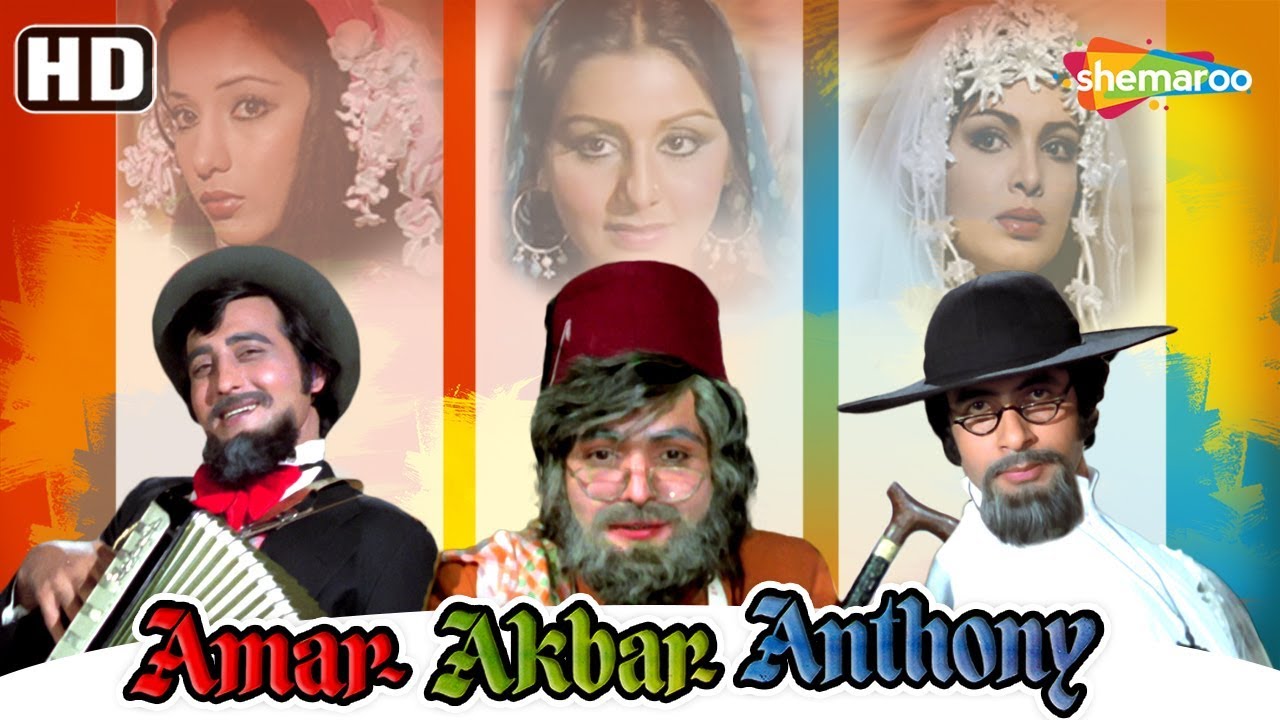
Then there are Hindi films that present God as this supremely unifying secular force. Though God may not be playing a key role in such films. In Amar Akbar Anthony, a commercial potboiler, three brothers separated in childhood, are raised by people from different religions. Clearly God's role here was to further the money making ability of the movie by pandering to people from different faiths. As more than religion, the brothers' vocations played an important role in furthering the story. Interestingly it played on stereotypes of these religions without offending its viewers as world was simpler then. Like Christian Anthony was an alcohol guzzling, local flirtatious lout while Muslim Akbar was a tailor and a part-time qawaali singer. 


There are several films where God is not present, but film-makers present mothers and doctors as Gods. A dying hero will wake up with the touch of his mother. Or a mother will kill several bad guys in an action film and imagery given to her would be of Goddess Kali. This would lend legitimacy to her actions and almost deify her. Then doctors are also messengers of Gods, as they don't treat patients but perform miracles, as suggested by Hindi films. Though off-late Hindi films have made new villains out of the doctors. Watch Gabbar is Back or I to know what I mean. Either a cliche should die a hero or live long enough to become a villain. (Quote rehashed from The Dark Knight).

An evergreen cliche which I must mention and the one which is often used as a device to further the story in Hindi Films, is that 'God is a Deal'. God has to perform miracles and prove itself over and over again. When a doctor gives up in Hindi Films, he comes out of Operation Theater and uses an oft repeated phrase. "Inhe dawa nahi dua ki zaroorat hai! " (He doesn't need medicine. He needs prayers)

An iconic scene from film Deewar, is the best representation of this cliche. A mega hero, Amitabh Bachchan, who is shown as an atheist throughout the film, goes to a temple to challenge the God  (prays in gangsta style). He challenges The God to prove himself and save his dying mother. Watch the scene with subtitles below. 

Disclosure: I write this post from a hospital today. I had a surgery done in the morning and have written this post under the influence of medication and in a really uncomfortable seating position. The word "Challenge" in this challenge lives up-to its name today. Mujhe Dawa aur Dua dono ki zaroorat hai! (I need both medicine and prayers).

---


Saturday, April 06, 2019

F : Food in Hindi Films / Bollywood #AtoZChallenge 2019

There are very few Hindi films that celebrate food in the truest sense. Stanley Ka Dabba (Stanley's Tiffinbox) really romances the food. It juxtaposes a child's hunger with the most delicious food to a devastating effect.  Lunchbox was another film where food builds bond between two strangers. Luv Shuv Tey Chicken Khurana though didn't show food the way such a film should, it really took me down the food lanes from the past. 

But let me not disappoint you. My challenge is to write about cliches in Bollywood. Here I will have to introduce Chekhov's Law. It states that ‘If in Act I (of any script or book or movie) you have a pistol hanging on the wall, then it must fire in the last act’ . The same is true for food in Hindi films. With a slight twist though. If food appears in a scene in a Hindi film, especially if there is a cake, there has to be a food fight soon after. This cliched scene has been used in several movies in past to mine some laughs from the gullible audience. 

But the following scene turns Chekhov's Law on its head. It has a gun and a food item (an Indian flatbread) playing a really important role. Please note this scene is meant to be an intense and emotional one. But when I see it today and without context of the whole film, it comes across as extremely hilarious and stupid. In this film, Izzatdaar (honorable) one of the protagonists doesn't fire the gun, because the other protagonist uses the flatbread as a shield. It is used as a metaphor for the mother's love, as the gun wielding protagonist has a strange emotional connect with that flatbread. 


Another Bollywood cliche related to food that I can recall is about the fight scenes that occur when hero is about to eat or already eating food. In these scenes the hero has to tackle the goons without letting the food fall down. Or he has to continue eating food oblivious to these goons and still beating them somehow with actions that are part of his food eating routine. Like as he picks his glass to drink water, his elbow will move side-wards hitting the goon who is about to attack him from that side. Of course it is not choreographed ;-) But some films are so bad that they don't get it right. In the following scene, hero is about to eat a really ugly looking item of food. Goons Attack! Hero fights back! And takes a winning bite! But food does fall down at one point of time! Epic fail!


Thankfully, Bollywood has done away with this cliche. Today's heroes look so lean, I doubt they eat food at all. But Mark Twain has a word of advice for them. "The secret of success in life is to eat what you like and let the food fight it out inside."


---